Description
Engineering Insight · UK Edition
Plastic Gear Racks for 3D Printers, Light Automation & CNC Motion Systems: The Complete Engineer’s Guide
How injection-moulded rack and pinion systems in acetal, POM, and nylon are quietly replacing metal in precision-driven UK industries — and why that matters for your next project.
 Walk the floor of any modern UK production facility — a medical device maker in Cambridge, a robotics integrator in the West Midlands, or an automated packaging line in Manchester — and you will almost certainly find a rack and pinion system at the heart of its linear motion. For decades, engineers defaulted to steel or aluminium for these components. Increasingly, that assumption is being challenged by high-performance plastic gear racks manufactured through precision injection moulding.
The shift is not driven by cost alone. Acetal (POM), nylon, and engineered polymer racks offer a genuinely different mechanical and operational profile — one that is frequently better suited to the demands of 3D printers, benchtop CNC routers, conveyor indexers, and laboratory automation platforms that define a significant portion of UK light-industrial output today. This guide draws on more than eighteen years of application engineering experience to walk you through what you actually need to know before specifying a plastic rack and pinion for your next system.
What Separates an Injection Plastic Gear Rack from Its Metal Counterpart
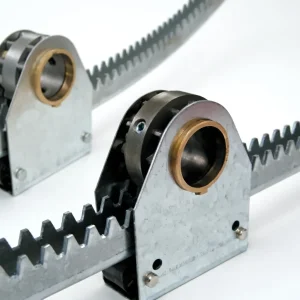
The mechanical principle of a rack and pinion is unchanged regardless of material: a linear toothed bar (the rack) meshes with a rotating circular gear (the pinion) to convert rotary motion into precise linear displacement. What changes dramatically between a steel rack and an injection-moulded acetal rack is the operational envelope within which each thrives.
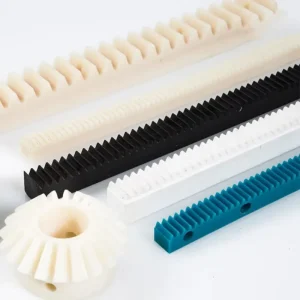
Plastic racks produced from acetal copolymer (POM-C), homopolymer acetal (POM-H), and PA66 nylon exhibit a self-lubricating surface chemistry that reduces — and in many low-load cases, eliminates — the need for external lubrication schedules. For systems running inside cleanrooms, food-adjacent environments, or sealed enclosures where grease contamination is unacceptable, this is not a convenience: it is a hard specification requirement. Engineers in UK pharmaceutical and food-processing sectors have increasingly adopted polymer racks precisely for this characteristic.
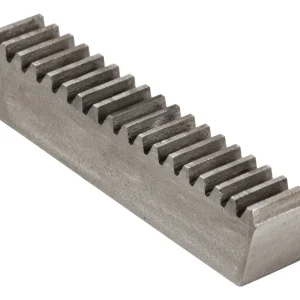
The tooth geometry of these racks uses a spur-cut (straight tooth) profile, which delivers consistent mesh engagement without the axial thrust forces that helical teeth introduce. For applications like 3D printer gantries, where servo or stepper motors are already managing tight torque budgets, the absence of axial loading is a meaningful design advantage. The low-noise spur tooth profile also keeps operating acoustics under control — something any open-frame 3D printer operator running overnight print cycles will appreciate immediately.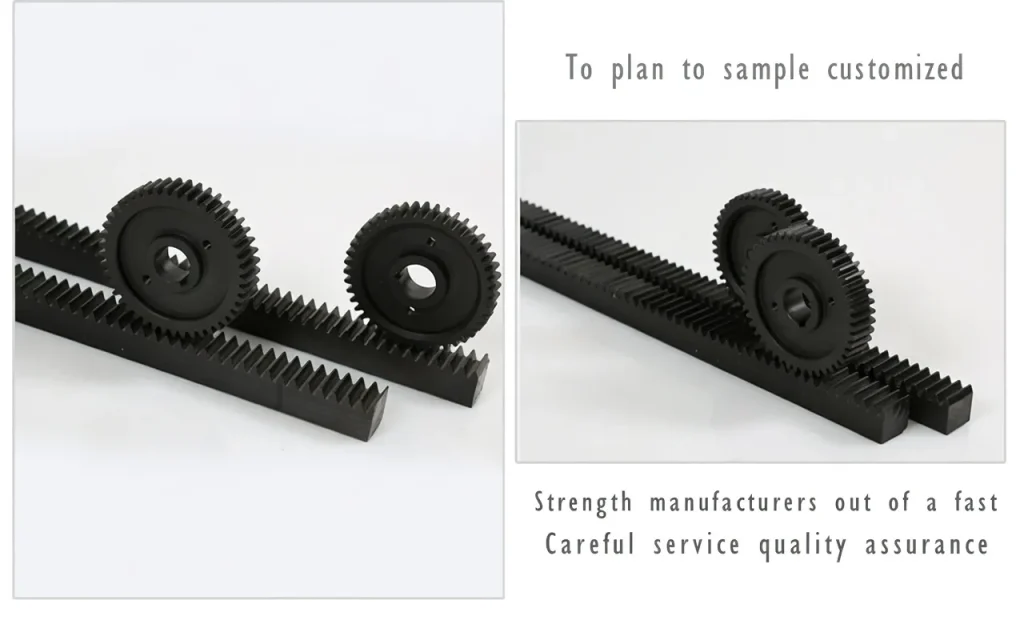
Technical Specifications at a Glance
Plastic Gear Racks in 3D Printing: Precision Where It Counts
The FDM and FFF 3D printing market in the United Kingdom has grown into a serious manufacturing tool — not merely a prototyping curiosity. Industrial gantry-style printers, CoreXY machines, and belt-driven large-format systems all rely on rack and pinion or belt-and-pulley arrangements for their primary axes. Among these, rack and pinion systems offer a positional rigidity that belts simply cannot match over long print beds.
When specifying a plastic gear rack for a 3D printer X- or Y-axis, the 0.8 MOD and 1.0 MOD modules are the most commonly selected. These strike the optimal balance between tooth strength at typical print-head loads (usually under 5 N) and the fine pitch resolution that avoids visible stepping artefacts on printed surfaces. The self-lubricating nature of acetal means the rack maintains consistent mesh friction over tens of thousands of traverse cycles, which directly translates into layer-to-layer dimensional consistency — something that degrades quickly on dry metal racks running without scheduled lubrication.
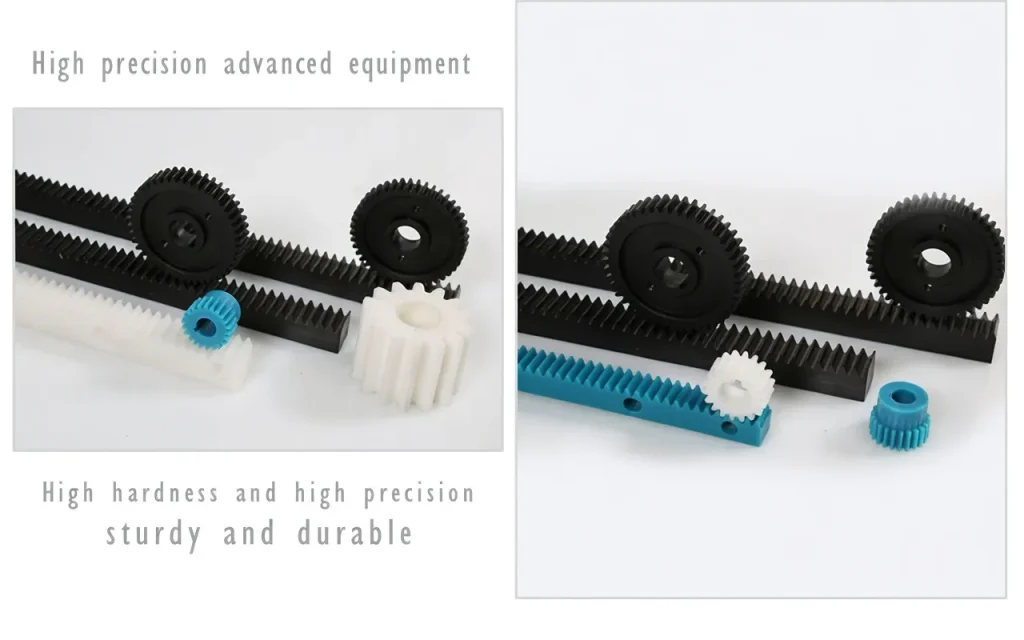
For printer builders and OEMs in the UK working on custom or semi-custom machines, the availability of these racks in matched sets — rack with flanged pinion gear, hub, side holes, and mounting screws — dramatically reduces BOM complexity and assembly time. A single-source rack and pinion kit eliminates the tolerance-stacking headaches that arise when sourcing the rack and pinion separately from different suppliers.
Light-Duty CNC Machines and Automation: Where Polymer Racks Outperform
Benchtop CNC routers, vinyl cutters, laser-engraving platforms, and pick-and-place assembly cells represent a broad category of machinery where payload forces are modest but cycle counts are extremely high. A small-format CNC router used for PCB milling, for instance, might execute 80,000–120,000 mm of linear axis travel during a single working week. Under these conditions, the choice of rack material has a direct bearing on noise levels, maintenance intervals, and the consistency of positional accuracy.
Nylon and acetal racks have a natural damping quality — their polymer molecular structure absorbs micro-vibration that would otherwise be transmitted through a metal rack into the machine frame and then into the cutting or marking tool. For engraving applications where surface finish quality is paramount, this damping effect is often the deciding factor in eliminating high-frequency chatter marks that show up on the finished part. Several UK-based CNC hobby and professional machine builders have switched to injection-moulded plastic rack and pinion pairs precisely for this reason.
Rack and pinion configurations are also the preferred linear drive solution when travel distances exceed 300 mm and positional stiffness matters more than ultimate back-drivability. Unlike ball screw systems, which require careful alignment and are expensive to source in long lengths, a plastic gear rack can be cut to any length on-site or ordered pre-cut, making it genuinely practical for prototype and low-volume automation builds in UK engineering workshops.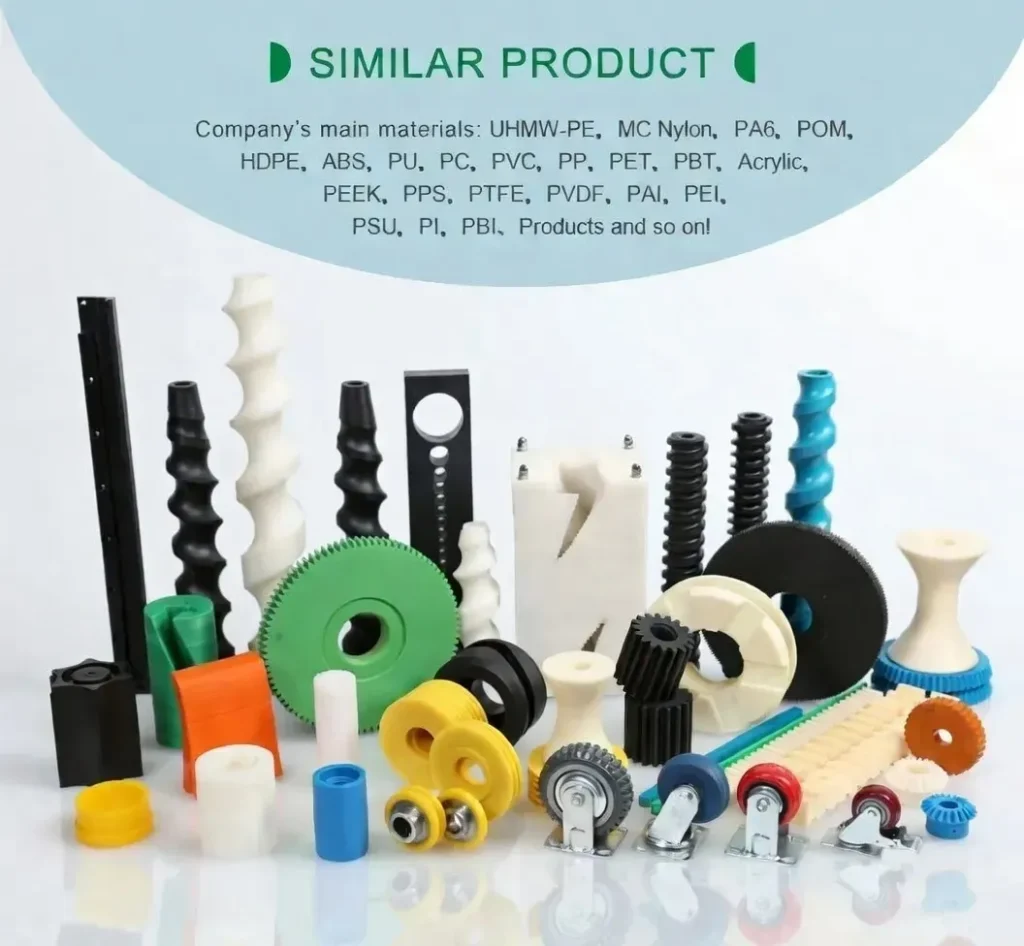
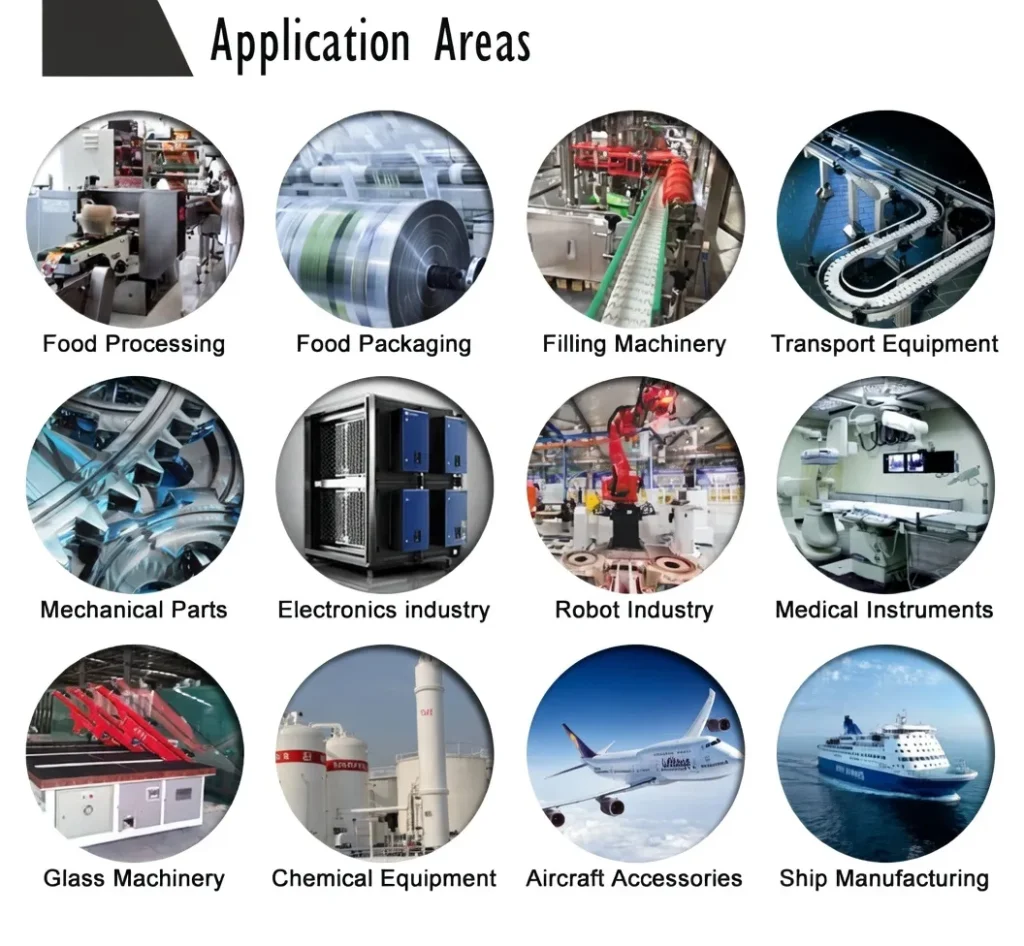
Key Application Scenarios Across UK Industries
3D Printers & FDM Machines
X/Y gantry axes in CoreXY, Cartesian, and large-format printers. MOD 0.8–1.0 most common.
Benchtop CNC Routers
PCB milling, foam cutting, vinyl engraving. Low noise, self-lubricating operation.
Conveyor & Indexing Systems
Packaging lines, pharma conveyor gates, and pick-and-place cell linear transfers.
Laboratory & Medical Devices
Autosamplers, pipette arms, diagnostic scanners — grease-free motion in cleanroom contexts.
Cranes, Elevators & Hoists
Light lifting gear, window lifts, and display elevation systems where corrosion resistance is vital.
Camera & Broadcasting Rigs
Motorised slider and dolly systems for broadcast, film production, and photography studios.
Material Selection: POM Acetal vs Nylon vs Steel — A Practical Comparison
Six Reasons Engineers Choose Plastic Gear Racks
🔔
Quieter Operation
Polymer tooth contact generates substantially less airborne and structure-borne noise than metal-on-metal mesh, critical in office-adjacent or residential workshop environments.
💧
No External Lubrication
Acetal’s inherent lubricity keeps maintenance schedules lean. Eliminated grease reapplication reduces unplanned downtime and prevents contamination in sensitive environments.
⚡
Lightweight Design
Polymer racks weigh roughly 1/7th of an equivalent steel rack. For servo-driven axes, this directly reduces required motor torque and energy consumption per cycle.
🛡️
Corrosion-Proof by Nature
No surface treatment, plating, or protective coating required. POM retains its dimensional accuracy in humid, damp, or splash-zone environments for years without degradation.
📈
Lower Total Cost
Lower unit price, reduced maintenance spend, and lower energy consumption combine to deliver a compelling lifetime cost advantage over steel alternatives in light-duty applications.
🛠️
Fully Customisable
Custom modules, tooth counts, outside diameters, and lengths are available via CNC or dedicated injection mould tooling — no minimum standard range required.
Customer Success: Midlands Robotics Integrator Cuts Maintenance Costs by 40%
Case Study — West Midlands, UK — Industrial Automation & Robotics Sector
A robotics integration company based in Coventry was upgrading a fleet of twelve pick-and-place cells for a Tier 2 automotive components supplier. The original build used steel rack and pinion assemblies on the linear Z-axis, which required monthly greasing and showed measurable wear within eighteen months of deployment. The customer needed a drop-in replacement that would survive a three-year service interval without scheduled lubrication.
After reviewing material datasheets and load calculations, the engineering team selected POM acetal plastic gear racks at 1.0 MOD, matched with flanged pinion gears to the same module. Installation across all twelve cells was completed in a single shift. After fourteen months of continuous two-shift operation, the racks showed no measurable dimensional change on CMM re-inspection and no lubrication had been applied. The customer reported a 40% reduction in maintenance cost on those axes and zero unplanned stoppages attributable to rack wear.
“The switch paid for itself within the first six months purely on eliminated maintenance labour. We have now standardised plastic gear racks on all low-to-medium load axes across our cell builds.” — Senior Mechanical Engineer, Coventry-based Robotics Integrator
What Our UK Customers Say
“We source all rack and pinion components for our laser-engraving tables from this supplier. The 0.8 MOD acetal racks have been running without issue for over two years. Zero lubrication, zero noise complaints from the office next door.”
— Mark T., Product Engineer
CNC Machine Builder, Sheffield, UK
“We needed a custom module and tooth count for a specialist laboratory autosampler. The team came back with drawings within 48 hours and delivered sample parts in under three weeks. Quality was exactly to spec.”
— Dr. Sarah L., R&D Lead
Life Sciences Equipment Manufacturer, Cambridge, UK
“Price point was competitive against UK distributors and the lead time was better than I expected for a custom order. The injection-moulded nylon racks have handled our food-line wash-down environment without any signs of degradation at the 12-month review.”
— James R., Mechanical Design Manager
Food Processing Automation Integrator, Leeds, UK
Custom Plastic Gear Rack Manufacturing: What We Can Build for You
Standard catalogue sizes are a starting point, not a constraint. The manufacturing facility operates both CNC machining cells and dedicated injection mould tooling production, which means the capability to produce plastic gear racks to virtually any specification exists in-house. For UK buyers placing orders for custom tooth counts, non-standard modules, bespoke outside diameters, or unusual rack lengths, the process is straightforward: submit a sample or a sketch, receive a detailed drawing for approval, and proceed to production.
The injection mould tooling route is particularly relevant for medium-to-high volume production runs where per-unit cost needs to be minimised and part-to-part repeatability is critical. Mould lead times range from 15 days for straightforward geometries to 35 days for more complex tooling. CNC-machined racks are the preferred route for prototyping, low volumes, or special geometry verification before committing to tooling investment.
The full quality assurance process includes video documentation of production, dimensional reports, and surface inspection records — all shared before despatch. For UK businesses that cannot visit the factory, this transparent reporting process effectively puts a representative on the production floor at every stage.
Supplying UK Engineers and Procurement Teams
For UK-based procurement teams and design engineers sourcing rack and pinion components, lead time reliability and documentation quality are consistently the two most critical buying criteria — ahead of unit price. The supply chain for these components is set up to serve both rapid-turnaround prototype orders (typically 15 days or less for standard items) and high-volume production runs with full traceability documentation.
Whether you are an OEM in the East Midlands designing the next generation of laboratory automation platforms, a system integrator in the South East specifying components for a bespoke conveyor line, or a machine builder in Scotland looking for a reliable plastic gear rack and pinion pair at a competitive price, the enquiry process starts with a single email to [email protected]. Quotes are typically returned within 24 hours. Urgent requests receive same-day responses when flagged.
Frequently Asked Questions
Ready to Source Plastic Gear Racks for Your UK Project?
Standard and custom modules available. CNC and injection-moulded production. 24-hour quotes. Get in touch today.
Get a Quote — [email protected]
edit by gzl