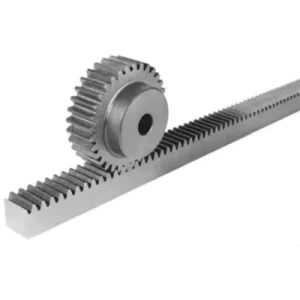
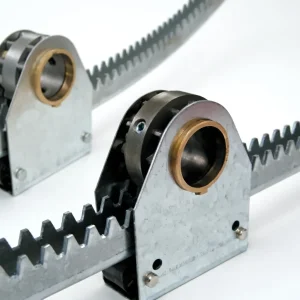
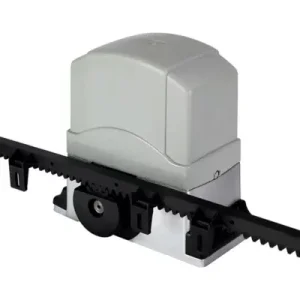
Description
 Sliding gate systems have become a staple of modern access control across the United Kingdom — from sprawling industrial estates in Birmingham and Manchester to private residential driveways in Surrey and Edinburgh. At the mechanical heart of every motorised sliding gate is a remarkably simple yet precision-critical component: the gear rack and pinion. When this interface fails, so does everything else. When it performs flawlessly, gate cycles run quietly, reliably, and for hundreds of thousands of operations without complaint. This guide exists because the gap between a gate rack that lasts five years and one that lasts twenty often comes down to specification decisions made at the purchasing stage — decisions that deserve far more attention than they typically receive.
Whether you are integrating a steel pinion M4 system into a new automated entrance, replacing worn components on an existing FAAC or BFT motor installation, or sourcing custom-profile racks for a bespoke gating solution, the principles covered here will help you select, install, and maintain gear rack systems that genuinely deliver. We draw on real project data, engineering standards, and field feedback from clients across England, Scotland, Wales, and Northern Ireland.
Product Showcase
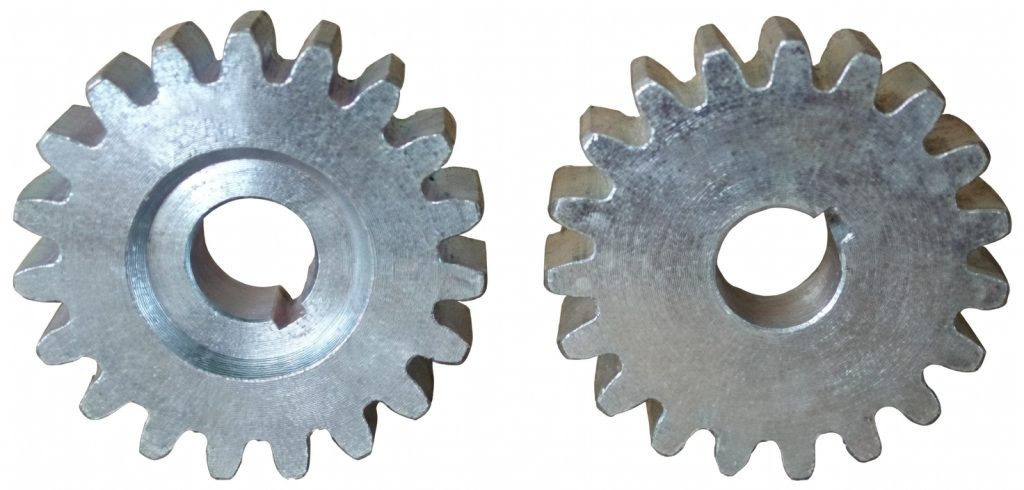
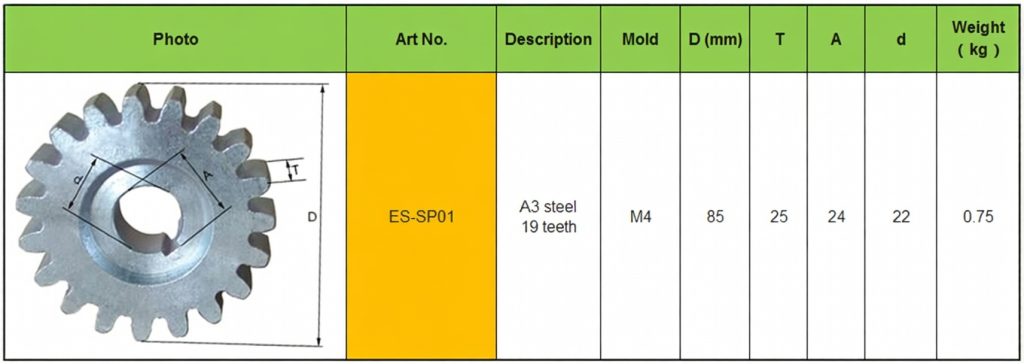
Steel Pinion for Sliding Gate Motor — Module M4, A3 Steel | Ever Power Manufacturing
Dimensional Reference Drawing
Why the Gear Rack Is the Most Overlooked Component in Gate Automation
Engineering Fundamentals
Talk to any gate automation installer in the UK and they will tell you the same story: the motor gets all the attention, but the rack takes all the abuse. Every gram of gate mass, every gust of wind loading, every impact from a leaf blower or an impatient vehicle driver — all of it ultimately transmits through the teeth of the gear rack into the pinion mounted on the motor shaft. The rack is the mechanical translator between rotary motor output and linear gate travel, and its performance characteristics define the ceiling of the entire system.
A Module 4 (M4) steel pinion manufactured from A3 grade steel represents the standard entry point for residential and light commercial sliding gate applications. The module figure — often misunderstood in procurement conversations — describes the ratio of pitch diameter to tooth count. Higher module values mean larger, stronger teeth capable of transmitting more torque and better tolerating contamination like grit and dust. For gates with significant mass or high cycle frequency, module selection alone can double the serviceable lifespan of the rack assembly. Understanding this single principle already puts you ahead of the majority of buyers in the UK market who specify purely on price per metre.
Technical & Performance Parameters
Steel Pinion for Sliding Gate Motor — M4 Series
What Sets These Gear Racks Apart From Generic Alternatives
Product Advantages
The UK sliding gate market is flooded with low-cost rack imported through multi-tier distribution chains, where quality control is an afterthought. When you specify gear racks from a manufacturer with dedicated heat treatment, in-house CNC hobbing, and rigorous dimensional inspection, the difference shows up not in the catalogue but in the field — after two years of daily cycling through British winters. Here is what actually matters in a well-engineered sliding gate gear rack system, and why each characteristic has measurable impact on total cost of ownership.
Heat-Treated A3 Steel Core
Unlike cold-drawn mild steel rack, our A3 steel undergoes controlled heat treatment transitioning the microstructure from martensite toward the optimal ferrite-bainite balance. This produces a rack tooth surface hard enough to resist abrasive wear from grit and debris while the core retains impact toughness — a balance that generic rack cannot achieve.
Precise Involute Tooth Geometry
Every rack section is hobbed to DIN 867 involute profile standards with 20-degree pressure angle. This geometry distributes load across the full face width of the tooth rather than concentrating stress at the tip, dramatically reducing the risk of pitting and spalling that leads to noisy, jerky gate operation — one of the most common complaints from UK gate automation engineers working with budget-market product.
Corrosion-Resistant Surface Options
Standard black oxide finish is augmented with optional zinc electroplating or hot-dip galvanising — both selected for compatibility with the UK’s damp maritime climate. Coastal properties from Cornwall to the Scottish Highlands present particularly aggressive salt-laden air conditions, and a gate rack without appropriate surface protection can develop surface corrosion within eighteen months of installation, accelerating tooth wear significantly.
Tight Dimensional Tolerances
Pitch accuracy of ±0.05 mm per metre ensures that multi-section installations maintain consistent meshing across the full gate travel. Poor pitch accumulation in a 4-metre gate run creates binding zones that increase motor current draw, trip thermal overloads prematurely, and ultimately cause motor failure — an expensive consequence of what initially appeared to be a minor dimensional shortfall.
Full Customisation Capability
From modifying the bore diameter and keyway profile to sourcing stainless steel variants for food-processing environments or specifying custom lengths for awkward gate configurations, our manufacturing team handles bespoke orders as standard practice. Samples, drawings, or even worn original parts can serve as the starting reference for a custom replication project.
Rapid Response & Consistent Supply
Standard M4 pinion and rack stock is held in quantity for fast-turnaround orders. UK gate automation contractors operating on tight installation schedules need a supplier who can commit to delivery windows and maintain those commitments across repeat orders — not a distributor reliant on a single factory run each quarter.
How the Rack-and-Pinion Mechanism Powers a Sliding Gate
Operating Principle & Materials Science
The operating principle is elegantly straightforward. A sliding gate motor — typically a 230V AC unit with an integrated gearbox — drives a small steel pinion gear mounted on its output shaft. This pinion meshes continuously with a toothed gear rack bolted along the underside or face of the gate panel. As the motor spins the pinion clockwise or anticlockwise, the teeth of the pinion engage successive teeth on the rack, converting the rotary motion into controlled linear movement of the gate along its guide rail. The entire system relies on maintaining correct meshing depth and backlash clearance — typically 0.1–0.3 mm for M4 systems — to balance smooth operation against impact absorption capability.
From a materials perspective, A3 steel (equivalent to Q235 in Chinese standards, or broadly comparable to S235 in European EN 10025 classification) provides an excellent baseline for residential and light commercial applications. Its carbon content of approximately 0.14–0.22% delivers reliable weldability — useful when the rack needs to be attached to gate frames with an irregular profile — and its yield strength of around 235 MPa is more than adequate for gates up to 600 kg at standard cycling frequencies of 30–50 cycles per day.
When heat treatment enters the picture, the transformation from the as-rolled microstructure (predominantly ferrite) through a martensite phase and then back to a controlled ferrite-bainite mixture using tempering represents a deliberate engineering trade-off. Pure martensite is extremely hard but brittle — unsuitable for a component that regularly absorbs shock loads from obstacles, gusts, or hard limit stops. The tempered structure combines surface hardness in the range of 38–45 HRC with a core that can absorb energy without cracking, giving the rack a fatigue life measured in millions of cycles rather than thousands.
Application Scenarios Across UK Industries
Where Sliding Gate Gear Racks Are Deployed
Gear racks for sliding gate motors appear across a remarkably diverse range of settings throughout the United Kingdom. The common thread is the need for reliable, repeatable linear actuation in an outdoor or semi-outdoor environment where contamination, weather, and varying load cycles create real engineering challenges. Below is a sector-by-sector breakdown of where M4 steel rack and pinion systems are actively deployed and what each context demands from the hardware.
Client Success: Midlands Logistics Park Access System Upgrade
Customer Case Study
🏭 Project: Coventry Distribution Hub — Gate Automation Retrofit
A third-party logistics operator based in Coventry, West Midlands, was experiencing systematic premature wear on sliding gate rack assemblies across four vehicle access points at their primary distribution centre. The existing rack — sourced through a local distributor — was showing tooth face pitting and surface corrosion within 14 months of installation, despite being nominally rated for 36 months. Gate noise had increased markedly, and motor current draw had risen 18% above baseline, triggering nuisance thermal shutdowns during peak lorry movements.
The facilities manager contacted Ever Power after an industry recommendation. Following a detailed review of the gate specifications — 680 kg fabricated steel cantilever panels, approximately 160 daily cycles per gate, operating in a partially sheltered yard environment with intermittent exposure to road grit and mild chemical contamination from cleaning agents — we recommended M4 A3 steel rack with heat treatment and zinc electroplating finish, paired with compatible M4 steel pinions.
Installation was completed by the client’s preferred gate automation contractor. After 26 months of operation at the same cycle rates, a follow-up inspection found zero measurable tooth wear beyond the expected running-in polish on the contact faces, motor current draw had returned to design baseline, and operating noise was described by the site team as “noticeably quieter than new.” The client subsequently specified the same rack system for two additional facilities in Northampton and Derby.
What Our UK Clients Say
❝
“We replaced generic rack on all six of our site gates with Ever Power M4 units two years ago. Not a single callout since. The dimensional consistency made installation straightforward and the wear performance at our Trafford Park depot has been genuinely impressive.”
— James H., Operations Director
Industrial Estate Management, Greater Manchester, UK
❝
“Our school gate motor was consuming excessive power and making grinding noises. After switching to the heat-treated rack from Ever Power, performance improved immediately. The technical support we received during specification was professional and genuinely helpful — they understood the application, not just the catalogue.”
— Sarah M., Estates Manager
Academy Trust, West Yorkshire, UK
❝
“We needed a custom bore and keyway configuration to match an unusual gearbox output shaft on a heritage property gate installation in Edinburgh. Ever Power turned around a production sample within 18 days from our drawing and it was dimensionally perfect. Pricing was competitive and communication was excellent throughout.”
— Callum R., Gate Automation Specialist
Bespoke Gate Systems Contractor, Scotland, UK
Manufacturing Capability & Custom Production Services
Ever Power Factory — Your OEM & Bespoke Partner
Our production facility operates dedicated CNC gear hobbing machines, in-house heat treatment furnaces with programmable atmosphere control, and a fully equipped metrology room with CMM capability. This end-to-end manufacturing flow — from raw steel billet to finished, inspected component — means we do not depend on sub-contracted machining for critical dimensional features. For UK buyers, this translates into genuinely consistent quality across repeat orders, not just across the first shipment.
Customisation is not a premium add-on at our facility — it is a standard operational capability. We regularly produce gear racks with non-standard modules, stainless steel compositions, modified tooth profiles for low-backlash applications, special bore and keyway configurations, and custom surface treatments including powder coating, hard chrome plating, and black phosphate. If your gate automation project involves an unconventional motor interface, an unusual gate geometry, or a specific environmental classification, our engineering team welcomes the challenge. We can work from 2D drawings, 3D CAD files, samples from worn originals, or even a detailed specification document — whatever your project requires as its starting point.
Minimum order quantities for standard items are deliberately low to accommodate UK contractors and system integrators who need small initial quantities for project commissioning before committing to stock orders. For ongoing supply agreements, we offer scheduled delivery programmes with fixed pricing and dedicated production slots — an arrangement that simplifies purchasing administration for facilities management companies and gate automation businesses managing multiple ongoing contracts across the UK.
Sourcing Gear Racks for Sliding Gate Projects in the United Kingdom
Supply Chain, Delivery & UK Market Context
UK buyers sourcing gear racks for sliding gate installations have historically relied on European distribution networks — predominantly German and Italian manufacturers whose products dominate the branded gate automation sector. While these products are excellent, their pricing often reflects multiple distribution layers, and lead times for non-standard sizes can stretch to 6–10 weeks. Direct-from-manufacturer sourcing from a vertically integrated precision gear manufacturer offers a compelling alternative: comparable or superior technical performance, substantially reduced cost per metre, and customisation flexibility that European distributors typically cannot offer at commercial pricing.
For gate automation contractors and installers operating across England, Scotland, Wales, and Northern Ireland, the practical consideration is lead time management. Standard M4 pinion and rack stock can be shipped to UK destinations via air freight with typical transit of 5–7 business days, or via sea consolidation for larger volume orders at significantly lower unit freight cost. Customs clearance processes for steel mechanical components from established manufacturers are generally straightforward, and we provide all necessary documentation including material certificates and dimensional inspection reports as standard inclusions with every shipment.
Procurement teams at UK facilities management companies, social housing providers, NHS property services, and local authority highways and infrastructure departments will find our structured supply programme straightforward to integrate with existing approved supplier frameworks. We are accustomed to providing documentation packs including ISO 9001 certification, COSHH data sheets, material test reports, and RoHS compliance declarations as required.
Frequently Asked Questions
Sliding Gate Gear Rack — UK Buyer Q&A
Ready to Specify or Order?
Talk to an Engineer — Get the Right Rack for Your Gate Project
Our team responds within 24 hours. Bring your specification, drawing, sample, or simply your gate dimensions — we will handle the rest.
edit by gzl