Beschreibung
 In the world of CNC machining, every micron counts. Whether you are operating a large-format gantry router in a fabrication shop in Birmingham, running a multi-axis milling centre in Sheffield’s precision engineering quarter, or managing an automated production line in the Midlands, the performance of your linear motion components directly determines the quality of every part that comes off your machine. Among all the motion transmission elements in a CNC system, gear racks are arguably the most critical for long-stroke, high-speed axis travel — and yet they remain one of the most underappreciated components in the drivetrain.
At Ever Power, we have spent nearly two decades supplying precision gear racks to CNC manufacturers, system integrators, and end users across the UK, Europe, and global markets. Our engineers understand that a gear rack is not simply a toothed bar — it is a precision-engineered transmission element whose geometry, material, surface hardness, and tooth accuracy class directly govern the repeatability, cycle speed, noise profile, and service life of your machine axis. This article explores the engineering behind gear racks for CNC machining centres, the material and design choices available, the real-world performance differences between accuracy classes, and how to select the right rack and pinion system for your specific application.
How Gear Racks Drive CNC Axis Motion
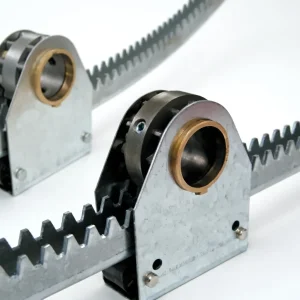
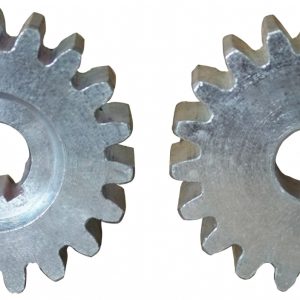
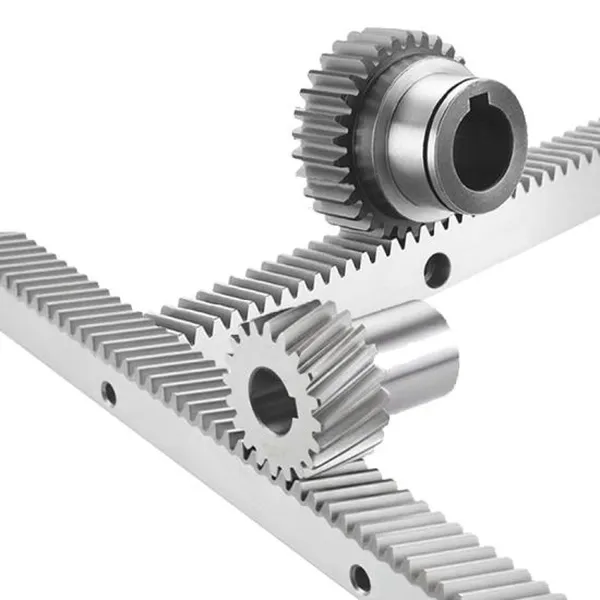
The operating principle behind a rack and pinion drive is elegantly simple, yet the engineering required to make it perform at CNC precision levels is anything but straightforward. A servo or stepper motor drives a pinion gear, which meshes with the gear rack mounted along the machine’s axis guide. As the pinion rotates, its teeth engage with the rack teeth and the carriage — carrying the spindle, tool head, or workpiece table — travels in a precise linear path. The speed of travel is directly proportional to the pinion’s rotational speed and diameter; the positioning accuracy is governed primarily by the tooth quality grade of the rack.
What distinguishes CNC-grade gear rack applications from general industrial motion is the demand for sub-millimetre repeatability over very long travel distances — often several metres — combined with high feed rates, dynamic acceleration, and the ability to maintain performance across tens of millions of duty cycles. A gantry-style CNC router machining aerospace composite panels, for example, may travel at 80 m/min while maintaining ±0.02 mm positional accuracy. Achieving this consistently over years of production requires not only a high-quality rack, but also precision rack installation, correct preloading of the pinion, appropriate lubrication management, and thermal compensation in some high-speed applications.
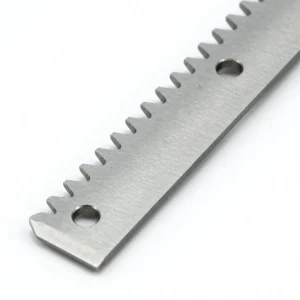
For extended axis lengths — common in large CNC cutting tables, plasma systems, and automotive press lines — multiple gear rack sections must be joined end-to-end. Standard gear racks joined without proper end preparation introduce pitch errors at every joint, which manifest as positioning inaccuracies and vibration at the pinion. Our machined-end gear racks solve this problem by ensuring that the tooth form is correctly configured at each end, so that the cumulative pitch error across a series of joined racks remains within the tolerance band of a single rack. This is a capability that separates professional-grade gear rack supply from commodity distribution.
Material Selection: The Foundation of Long-Service Rack Performance
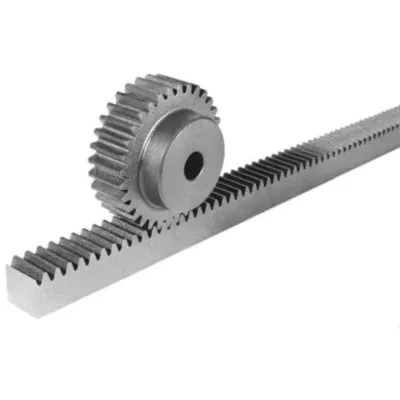 Material choice for a CNC gear rack is not a single decision — it is a matrix of trade-offs between core hardness, surface hardness, toughness, machinability, and cost. The wrong material choice can result in premature tooth wear, pitting, or catastrophic failure under dynamic loads. The right choice delivers tens of thousands of hours of reliable service even in demanding environments such as those found in Sheffield’s tool steel machining shops or the heavy-duty fabrication lines serving the UK’s offshore energy sector.
Carbon and alloy steels remain the predominant material for CNC gear racks. Medium-carbon steel grades such as C45 (equivalent to EN8 in the UK) offer good machinability and respond well to induction hardening, delivering a case hardness of 54–62 HRC at the tooth surface while retaining a tough, ductile core. This combination is highly effective for high-cycle CNC axes where both wear resistance and impact resilience are required. For even higher demands — particularly in heavy-gantry machining of structural steels, stone, or thick aluminium — alloy steels such as 42CrMo4 (EN19) provide greater core strength and superior hardenability, critical when rack cross-sections are large and through-hardening is impractical.
Where corrosion is a concern — for instance in CNC waterjet cutting systems, food-industry machining equipment, or installations in coastal UK facilities — stainless steel gear racks offer a practical solution, though engineers should be aware that most stainless grades cannot be hardened to the same surface hardness as carbon steel, which introduces a wear-rate trade-off. In applications where load levels are modest and noise reduction or weight saving is a priority, engineering plastics such as nylon, Delrin, or acetal are excellent choices, providing self-lubricating properties and eliminating metal-to-metal contact noise entirely.
Technical Performance Parameters — CNC Gear Rack Reference
| Parameter | Standard Grade (Q8–Q10) | Precision Grade (Q5–Q7) | High Precision (Q3–Q4) |
|---|---|---|---|
| Modulbereich | 1 – 8 mod | 1 – 6 mod | 0.5 – 4 mod |
| Tonhöhenabweichung | ±0.10 mm / m | ±0.04 mm / m | ±0.015 mm / m |
| Oberflächenhärte (Induktion) | 48–56 HRC | 54–60 HRC | 58–62 HRC |
| Typical Feed Rate | Up to 40 m/min | Up to 80 m/min | Bis zu 120 m/min |
| Standard Stock Length | 500 mm – 3.000 mm | 500 mm – 2,000 mm | Custom to spec |
| Typical Material | C45 / EN8 | 42CrMo4 / EN19 | 20MnCr5 / EN36 |
| Backlash (typical) | 0.10 – 0.20 mm | 0.04 – 0.08 mm | 0.01 – 0.03 mm |
| Profile Options | Straight / Spur | Gerade oder spiralförmig | Helical (20° helix angle) |
Key Application Scenarios for CNC Gear Racks
Gantry CNC Routers
Large-format gantry machines machining wood, aluminium, and composite panels rely on dual-rack drive systems for balanced X-axis load distribution. Helical gear racks at Q6–Q7 accuracy deliver smooth, quiet travel at high traverse speeds while maintaining the geometric accuracy essential for furniture, aerospace, and signage production.
Plasma & Laser Cutting Tables
Flat-bed plasma and fibre laser cutting systems used extensively in UK steel service centres and fabrication shops demand gear racks with low pitch deviation across joined lengths exceeding 6–12 metres. Machined-end racks ensure seamless tooth continuity at every joint, eliminating the stepped positional errors that would otherwise cause cut-path deviation and scrap.
Vertical Machining Centres (VMC)
In vertical machining centre table drives and tool-changer magazines, gear racks operate under complex bidirectional load cycles with rapid acceleration and deceleration. The hardened tooth flanks of our induction-hardened racks resist pitting and wear under these dynamic conditions, maintaining tooth profile integrity over millions of cycles in demanding production environments across the UK’s precision engineering sector.
Pallet Shuttle & Conveyor Systems
Automated pallet shuttle systems integrated with CNC machining centres use stationary gear racks to index pallet positions with absolute repeatability. The pallet-mounted pinion rolls along the fixed rack, providing positive, slip-free positioning that cannot be achieved with friction or belt drives — critical when heavy workpiece pallets must be exchanged rapidly between machining stations in lights-out manufacturing facilities.
Why Gear Racks Outperform Ball Screws in Long-Stroke CNC Applications
No Length Limit
Ball screws suffer from whip and deflection beyond approximately 4 metres. Gear racks can be extended indefinitely by joining machined-end sections, making them the only viable drive technology for CNC machines with stroke lengths of 6, 10, or even 20+ metres.
Hohe Belastbarkeit
Gear racks transmit force through robust tooth engagement across the full face width, giving them a significantly higher dynamic load rating per unit length than comparably sized ball screws — ideal for heavy-gantry and heavy-pallet CNC applications common in UK heavy engineering.
High Speed Capability
Rack and pinion drives routinely achieve traverse speeds of 80–150 m/min in production CNC systems, compared to ball screw limits of typically 30–60 m/min — a decisive advantage in high-throughput cutting, routing, and material handling applications.
Mechanical Simplicity
The rack and pinion mechanism is mechanically simple, with fewer failure modes than recirculating ball assemblies. Maintenance is straightforward — tooth wear can be assessed visually, lubrication is easy to apply, and rack sections can be replaced individually without dismantling the entire drive system.
CUSTOMER SUCCESS STORY · UK AEROSPACE FABRICATION
Reducing Axis Positioning Errors by 73% on a 10-Metre Gantry CNC Router — Midlands Aerospace Composite Specialist
 A precision composite component manufacturer based in the West Midlands, supplying structural panels for the UK’s commercial aviation supply chain, approached our technical team with a persistent quality problem. Their existing large-format CNC router — a 10-metre gantry machine used for trimming and drilling carbon-fibre-reinforced polymer (CFRP) panels — was generating cumulative X-axis positional errors of up to 0.28 mm over its full travel length, causing rejected panels and costly rework. The root cause traced to sub-standard gear rack joints on their original drive system: the racks had not been machined to controlled tolerances at the joining ends, creating pitch spikes at every 2-metre interval along the axis.
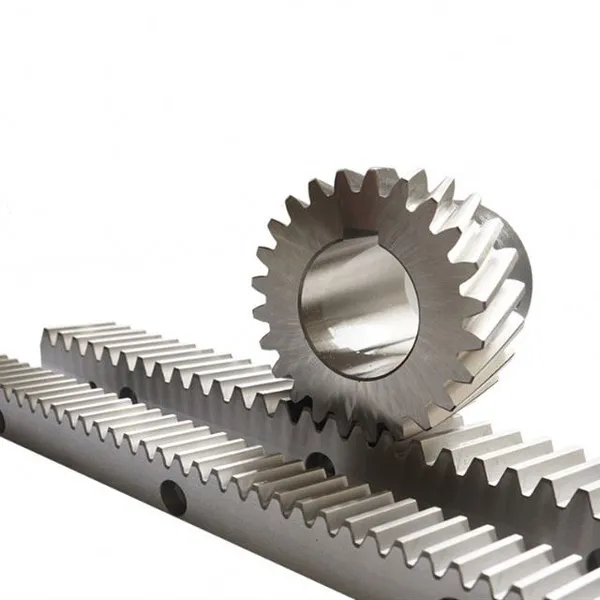
Ever Power supplied a full replacement set of Q6-grade helical gear racks in 42CrMo4 alloy steel with precision-machined ends, induction-hardened to 58 HRC at the tooth surface. Our application engineer provided a detailed rack installation specification, including torque values for mounting bolts, flatness tolerances for the mounting rail, and a recommended pinion preload procedure to minimise backlash. Following installation and commissioning, the customer measured a maximum positional deviation of 0.076 mm across the full 10-metre axis length — a 73% improvement in positioning accuracy. Panel scrap rates dropped from 4.2% to below 0.5% within the first production month, delivering a return on investment in under eight weeks.
Was unsere britischen Kunden sagen
„
We have sourced precision gear racks from Ever Power for three successive machine builds. The consistency between batches is exceptional — our machine builder team can install without re-measuring every rack section. The technical support before and after the sale is genuinely the best we have encountered from any rack supplier in Europe.
— James H., Chief Engineer · CNC Machine Builder · Yorkshire, UK
„
Our plasma cutting operation runs two shifts daily, six days a week. The hardened helical racks from Ever Power have now completed over 18 months of service without any measurable tooth wear beyond acceptable limits. We requested custom-drilled mounting hole patterns and received exactly what was specified. Delivery to our South Wales facility was faster than any previous supplier.
— Rachel M., Production Manager · Steel Service Centre · Cardiff, Wales
„
I was sceptical about sourcing gear racks internationally for our Edinburgh facility, but the documentation, material certificates, and dimensional inspection reports that came with the shipment were thorough and professionally presented. Every rack measured within tolerance on arrival. The pricing for the quantity we needed was also significantly more competitive than UK distributors were quoting.
— Stuart B., Procurement Lead · Precision Machining · Edinburgh, Scotland
OUR MANUFACTURING CAPABILITY
Custom Gear Rack Solutions — Built to Your Exact Specification
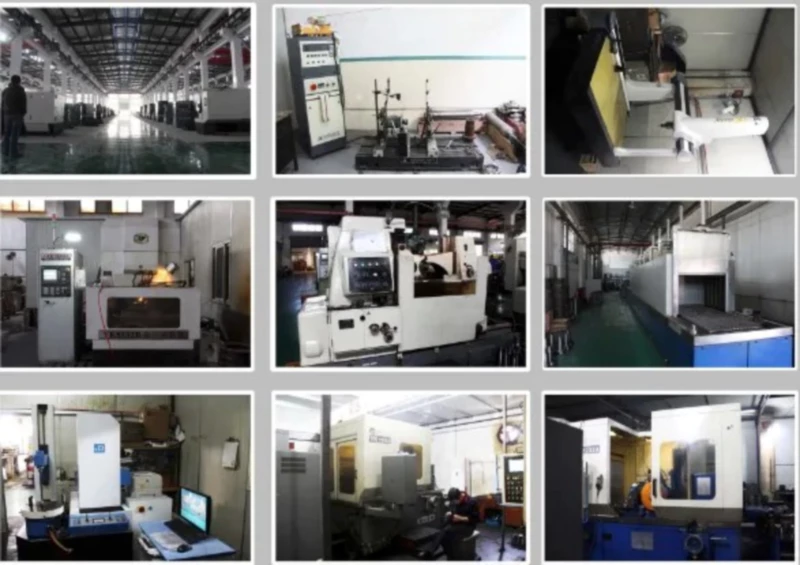
Our gear rack manufacturing facility operates with a full suite of CNC gear hobbing, gear grinding, and induction hardening equipment, supported by in-house coordinate measuring machine (CMM) inspection capable of verifying tooth form, pitch accuracy, and surface finish to international quality standards. Every batch of gear racks manufactured for UK customers comes with full material traceability documentation and dimensional inspection records — the level of quality assurance that precision CNC machine builders and system integrators demand and deserve.
Custom gear rack capabilities include: non-standard modules and pressure angles; custom rack lengths with precision-machined ends; custom cross-sections (rectangular, square, or round profile); threaded or tapped mounting holes to custom bolt patterns; special coatings including zinc phosphate, electroless nickel, and hard chrome; curved rack segments for arc-motion systems; and complete rack-and-pinion drive sets with matched helical pinions, mounting brackets, and lubrication accessories. Our engineering team works directly with CNC machine designers and system integrators across the UK and Europe to develop optimised rack and pinion solutions from the concept stage through to full production supply.
Serving the UK’s CNC & Precision Engineering Industry
The United Kingdom maintains a substantial and sophisticated CNC machining industry, concentrated in several key regional clusters. The West Midlands — historically the heart of British manufacturing — is home to a dense network of precision machining companies serving automotive, aerospace, and defence supply chains, all of which rely on high-quality linear motion components including Zahnstangen. South Yorkshire and the Sheffield City Region host some of Europe’s most advanced precision engineering businesses specialising in advanced alloy machining, where gear rack accuracy grades and material certification standards are non-negotiable. Scotland’s aerospace and energy sectors, centred around Glasgow and Edinburgh, and the North West’s aerospace concentration around Warrington, Salford, and Preston represent further significant markets for precision CNC gear racks.
Ever Power supplies gear racks and rack-and-pinion drive systems to UK customers through a streamlined direct-supply model, supported by our dedicated UK technical liaison team. We hold documentation compliant with UK conformity requirements, provide REACH and RoHS compliance statements for relevant material grades, and can supply material test certificates traceable to EN 10204:2004 standards — the documentation framework familiar to UK quality engineers and procurement professionals. Lead times for standard stocked products to UK mainland addresses are typically 5–10 working days, with expedited options available for urgent production requirements.
FAQPage + Speakable Schema
Frequently Asked Questions — Gear Racks for CNC Machining Centres
What is the best gear rack accuracy grade for a CNC router used in aerospace composite machining in the UK?
For aerospace composite CNC routing applications in the UK, we recommend a minimum of Q6-grade gear racks, and Q5 or better for long-stroke axes exceeding 6 metres. This accuracy class provides pitch deviation within ±0.04 mm per metre, which supports the positional repeatability required for close-tolerance CFRP panel trimming and drilling while remaining compatible with most standard servo drive systems. Helical tooth profile in this grade further reduces dynamic excitation and noise at high traverse speeds.
How much does a precision gear rack for a CNC plasma cutting machine cost, and where can I get a supplier quote in the UK?
Pricing for CNC plasma cutting gear racks varies based on module size, accuracy grade, material specification, rack length, and quantity. Standard Q8-grade straight racks suitable for plasma cutting tables are generally more affordable than precision helical grades. For a UK-specific price and lead time, we recommend contacting our team directly at [email protected] with your module, total axis length, mounting hole pattern, and quantity requirements. We provide detailed quotations typically within 24 hours for UK enquiries.
Which gear rack material is most suitable for a CNC machining centre operating in a corrosive or wet cutting environment near coastal UK areas?
For CNC machining environments with significant moisture, coolant exposure, or coastal salt-laden atmospheres, stainless steel gear racks are the primary material recommendation where load and speed requirements permit. For heavier-load applications where stainless steel’s lower surface hardness is a concern, zinc-phosphate-coated or hard-chrome-plated carbon steel racks with a consistent lubrication programme offer a practical and cost-effective alternative. Our engineering team can advise on the most appropriate material specification for your specific site conditions anywhere in the UK.
How do I join multiple gear rack sections together for a long CNC gantry axis without introducing pitch errors at the joints?
The correct approach is to use gear racks with precision-machined ends — sometimes called “connectable racks” or “racks with machined joining faces.” These have the tooth form correctly finished right to the end of each rack section, so that when two adjacent sections are butted together, the tooth pitch is continuous and the pitch deviation at the joint falls within the tolerance band of the rack’s accuracy grade. Simply butting standard racks end-to-end introduces a pitch spike that shows up as a positioning error each time the pinion crosses a joint. We supply machined-end gear racks in all standard modules and accuracy grades for long-axis CNC applications.
What is the difference between a helical gear rack and a straight gear rack for CNC machine axis drives, and when should I choose each type?
Straight (spur) gear racks have teeth parallel to the rack axis and provide straightforward, no-thrust-force engagement — simpler to install and suitable for lower-speed, lower-load applications or where cost is a primary concern. Helical gear racks have teeth cut at an angle (typically 15°–20° helix angle), which gives progressive tooth engagement along the full tooth length. This produces smoother, quieter motion with less dynamic excitation — especially important at traverse speeds above 40 m/min or in applications where vibration affects surface finish. The trade-off is that helical racks generate an axial thrust force that must be absorbed by the axis bearing arrangement. For most modern CNC machining centres, helical gear racks are the preferred choice.
Can I get custom-length gear racks with non-standard mounting hole patterns for a bespoke CNC machine build in a UK engineering facility?
Yes — custom gear racks are a core part of our manufacturing offer. We regularly produce gear racks to non-standard lengths, custom cross-section dimensions, specific drilled and tapped mounting hole patterns, and special surface treatment specifications for UK machine builders and system integrators. Custom orders are supported by a full technical consultation process with our application engineering team to ensure the rack specification matches the structural and kinematic requirements of your machine. Please contact us at [email protected] with your drawings or specification sheet to start the process.
Ready to Specify Your CNC Gear Rack Solution?
Our application engineers are ready to help you select the correct gear rack grade, material, and configuration for your CNC machining centre. Contact us today for a detailed technical consultation and competitive quote.
bearbeitet von gzl