Περιγραφή
Gear Racks for Passenger Elevators: The Complete Engineering Guide for UK Building Projects
With over 18 years of hands-on application engineering experience across vertical transportation systems, I’ve seen what separates a high-performing elevator from one that causes endless maintenance headaches. In almost every case, the critical difference comes down to the quality and specification of the gear rack. This guide walks you through everything you need to know — from material science to installation alignment — to make the right procurement decision for your UK building project.
Why the Gear Rack Is the Backbone of Every Elevator System
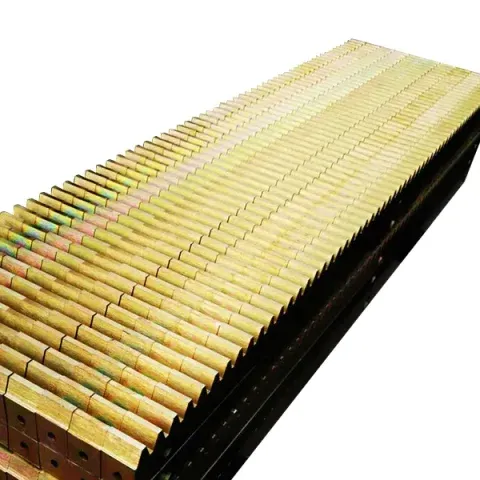 When engineers and procurement managers in the UK talk about elevator reliability, conversation naturally gravitates toward motors, control systems, and safety brakes. Yet time after time, field data from lift maintenance companies across London, Manchester, and Birmingham points to the gear rack as the single component most responsible for long-term system behaviour. A gear rack for elevator applications is not simply a toothed bar — it is a precision-engineered transmission element that converts rotational drive motion from a pinion into controlled vertical displacement of the car. Every millimetre of floor-to-floor travel, every smooth deceleration at landing level, every kilogram of passenger load is mediated through the tooth-to-tooth contact between rack and pinion. Get this interface right, and the entire system performs with quiet, accurate efficiency for decades. Specify it poorly, and you face a cascade of problems: vibration noise that disturbs building occupants, premature tooth wear that triggers unplanned shutdowns, and positioning drift that creates tripping hazards at doorways. Understanding the engineering behind the gear rack is therefore not optional knowledge for any UK lift professional — it is foundational.
Material Composition and Manufacturing Precision
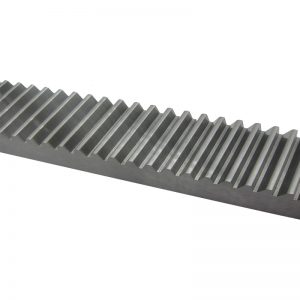
The performance envelope of any gear rack for elevator use is defined almost entirely by the material from which it is produced and the precision with which the teeth are formed. At EVER POWER, the standard manufacturing route begins with medium-carbon alloy steel, typically a grade equivalent to EN 8M or EN 16T under British Standards, which provides the ideal balance between machinability, surface hardness, and core toughness. The billets are rough-machined before case hardening — usually through induction hardening targeted at the tooth flanks and roots — bringing surface hardness to 56–62 HRC while preserving a tough, ductile core that resists shock loading. Tooth profiles are then finished by precision grinding to achieve the specific module, pressure angle, and lead accuracy required for the application. For standard passenger elevator duty in UK residential or commercial buildings, a module range of M4 to M12 is most common, with pressure angles of 20 degrees being the accepted norm. Pitch accuracy is verified against DIN 3962 or equivalent ISO 1328 tolerances, with most elevator-grade racks supplied to Q6 or better. This level of precision matters because positioning error at the landing level — even a deviation of 2–3 mm — creates a step between car floor and building floor that is both a tripping hazard under UK Building Regulations Part M and a liability exposure for the building owner.
Technical Specifications: Gear Rack for Elevator — Reference Table
How the Rack-and-Pinion Drive System Actually Works
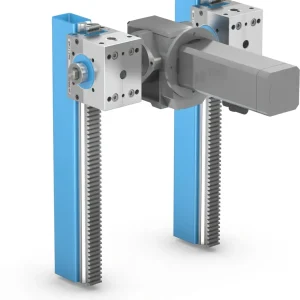
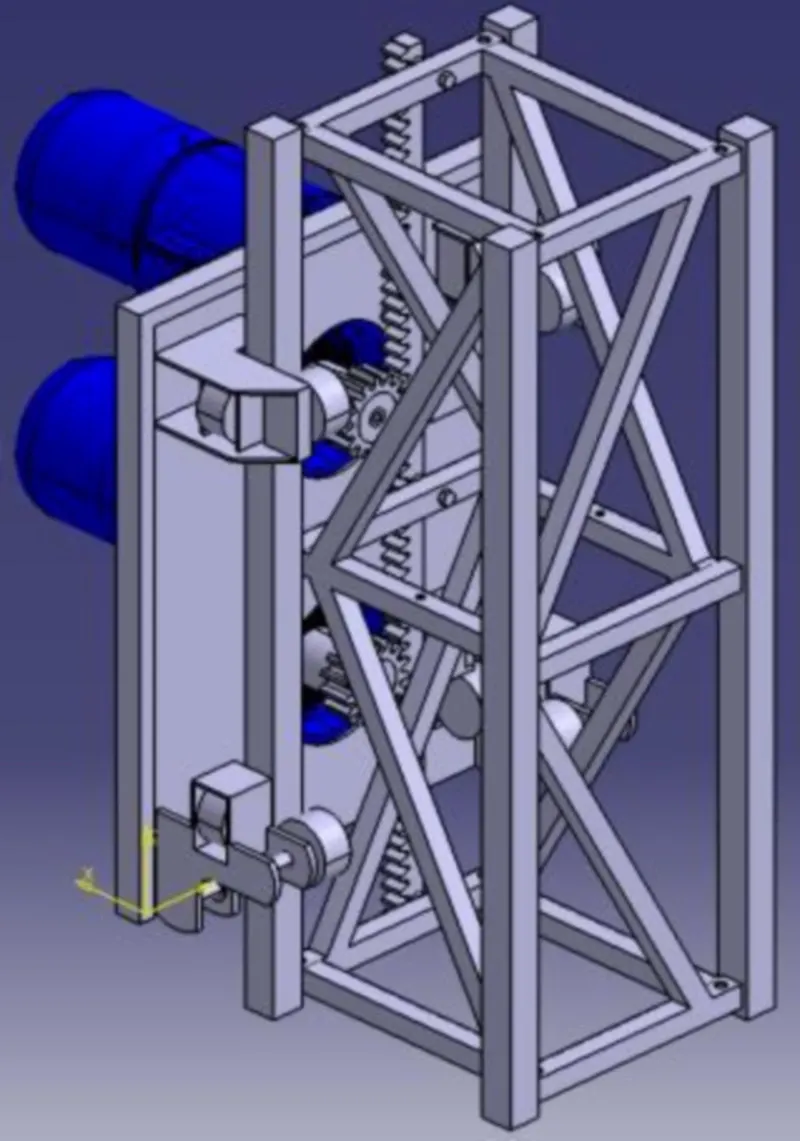
The operating principle of a rack-and-pinion elevator drive is elegantly straightforward, yet the engineering details that make it reliable in practice are anything but trivial. The gear rack is mounted vertically along the elevator shaft wall or guide-rail structure, running the full travel height of the installation. A driven pinion gear — attached to the elevator car frame and connected via gearbox to the drive motor — meshes continuously with the rack teeth as the car moves up or down. When the motor turns the pinion clockwise, the car rises; anticlockwise rotation descends. The gear engagement translates rotational torque directly into linear thrust force on the car, with no intermediate cable, chain, or hydraulic fluid in the force path. This gives the rack-and-pinion configuration several inherent advantages over hydraulic and traction rope systems: it is mechanically positive (no slip, no stretch), it allows precise incremental positioning through encoder feedback on the pinion shaft, and it is inherently suitable for inclined or vertical installations without the counterweight infrastructure that traction lifts require. For UK buildings where machine-room-less design is preferred and shaft space is at a premium, this compactness is a significant commercial advantage. Anti-backlash designs — where spring-loaded secondary pinions maintain contact pressure on both tooth flanks simultaneously — further eliminate the positional dead-band that causes the slight jolt passengers sometimes feel when drive direction reverses. Noise reduction is achieved through helical tooth geometry, which distributes load across multiple teeth simultaneously rather than concentrating impact on a single tooth pair as straight-cut racks do.
Application Scenarios Across UK Building Types
Residential High-Rise
From London’s Canary Wharf apartment towers to Manchester’s Deansgate residential blocks, gear racks for passenger elevators deliver the quiet, smooth ride that residents demand. Low-noise helical profiles and anti-vibration mounts ensure operation below 55 dB(A), meeting typical UK residential noise guidelines. Precise landing accuracy keeps every floor threshold flush, satisfying both Part M accessibility requirements and building warranty conditions.
NHS Hospitals and Healthcare
Hospital elevators in the UK face uniquely demanding duty cycles — bed-movement lifts may complete 200+ starts per day carrying loads of 2,000 kg or more. Our gear racks are specified to handle these conditions with hardened tooth profiles that resist the micro-pitting fatigue that standard grades would suffer under such repetitive loading. Quiet operation is equally critical: rack-and-pinion systems in hospital environments must not disturb patient recovery or clinical monitoring equipment, making low-noise helical designs the preferred choice.
Industrial and Freight
Freight elevators in UK distribution centres, automotive plants, and food processing facilities place enormous demands on the gear rack — impact loads from forklift placement, constant duty cycles, and the corrosive environments found in cold stores or washdown areas. EVER POWER supplies stainless steel and surface-coated gear rack options specifically engineered for these environments, with load ratings up to 20,000 kg available as a custom specification for heavy industrial applications across the Midlands and North of England.
Retail and Shopping Centres
Major UK retail developments — from Birmingham’s Bullring to Edinburgh’s Princes Mall — rely on service elevators to move stock, cleaning equipment, and maintenance crews between floors around the clock. Our gear racks for service elevator use are selected for their combination of load capacity, operational consistency, and long maintenance intervals. Properly lubricated at recommended intervals, a quality gear rack in retail service duty can achieve 80,000+ hours of operational life before requiring replacement.
Key Performance Advantages That Define the Difference

Efficient Power Transfer
Direct mechanical engagement achieves 95%+ transmission efficiency — outperforming hydraulic systems by a significant margin and reducing operating energy costs over the building’s lifetime.
Floor-Level Precision
Landing accuracy within ±1 mm is routinely achieved with a properly specified and installed gear rack system, exceeding the EN 81-20 landing zone requirement and eliminating tripping hazards.
High Load Capacity
Standard passenger configurations handle up to 5,000 kg; heavy-duty custom designs extend this to 20,000 kg and beyond, covering the full spectrum of UK elevator applications.
Μεγάλη διάρκεια ζωής
Case-hardened tooth profiles and precision-ground surfaces combine to deliver a service life that frequently exceeds 20 years in normal passenger elevator duty with routine maintenance.
Customer Success Stories
“We specified EVER POWER gear racks for a 24-storey residential tower in Leeds — 4 elevator shafts, each rack running 72 metres of vertical travel. After 3 years of operation, landing accuracy is still within spec, and we haven’t had a single tooth wear issue. The technical support team helped us match module and heat treatment to our duty cycle before any order was placed. That’s the kind of supplier relationship you want on a major project.”
“Our NHS trust upgraded the freight elevator in our main hospital in Birmingham. The old gear rack had been failing repeatedly under the bed-transport loads. EVER POWER’s custom M10 helical rack with 42CrMo4 steel solved the problem completely. Quieter than anything we’d used before, and the 12-month post-installation inspection showed no measurable wear on the tooth flanks. Procurement was straightforward and delivery to Birmingham was faster than expected.”
“We run a regional distribution centre in Coventry and had been battling excessive vibration noise from the goods elevator for over a year. Three different local suppliers couldn’t diagnose it properly — it turned out to be a non-standard pitch accumulation error in the original rack. EVER POWER’s team identified the issue from our measurements, quoted a replacement ground rack to Q5 accuracy, and the difference was immediate. We’ve since standardised on EVER POWER racks across our entire UK logistics estate.”
About EVER POWER — Manufacturing Capability and Customisation
Factory and Production Capacity
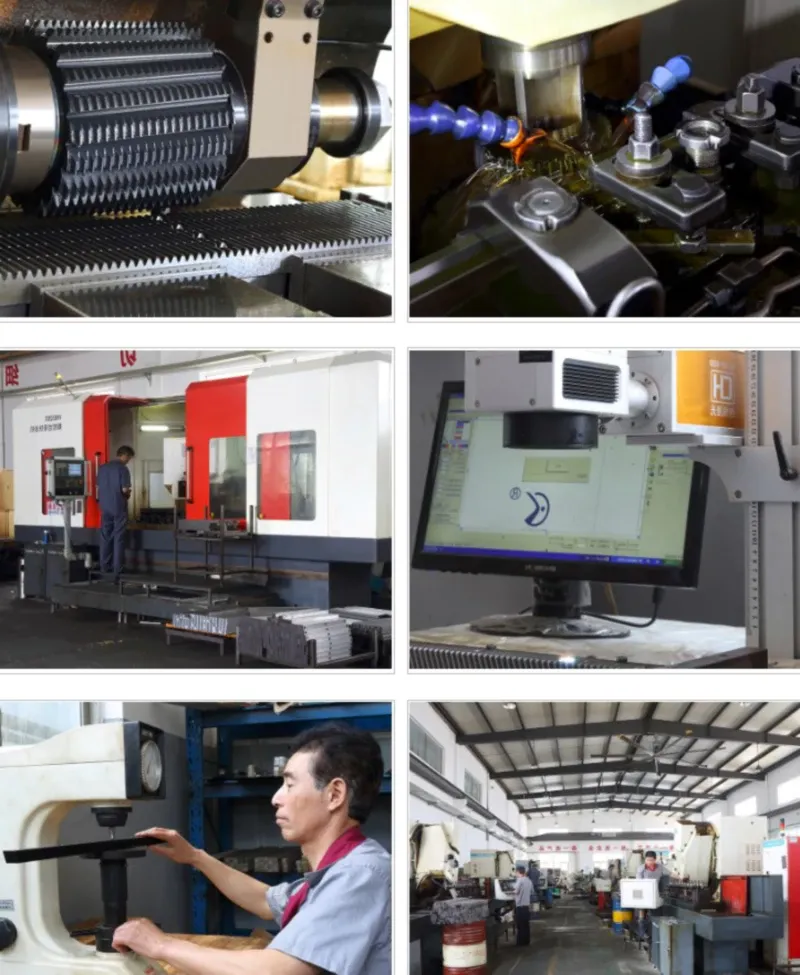
EVER POWER is a dedicated gear rack manufacturer based in China with direct export relationships throughout Western Europe — including a strong network of UK-based lift companies, OEM integrators, and maintenance contractors. The facility employs hundreds of engineers and production staff, with fixed assets of 20 million yuan and annual output exceeding 50 million yuan in value. Production is monitored through 16 full-process control systems, and dimensional verification is performed with optical projectors and coordinate measuring equipment. Every batch of gear racks for elevator applications ships with full material certificates and dimensional inspection records.
What genuinely sets EVER POWER apart for UK buyers is the depth of the customisation capability. Standard catalogue items — straight and helical gear racks in module M4 through M12, lengths to 3,000 mm, in 45# steel or 42CrMo4 — can be quoted and despatched within days. Beyond the catalogue, the engineering team supports full custom projects: non-standard modules, extended section lengths to 6,000 mm, double-helical profiles, stainless steel or anti-corrosion coated variants for food processing or offshore elevator applications, and precision Q5 ground racks for high-speed lift systems. If your UK project has a specification that doesn’t fit a standard product, that is exactly where EVER POWER’s engineering consultation service adds the most value.
Installation, Alignment, and Maintenance Essentials
Even the best-specified ράφι εργαλείων for elevator use will underperform if installation is not executed with care. The rack must be mounted in continuous straight sections, aligned parallel to the elevator guide rails within the tolerances specified by the drive system manufacturer — typically less than 0.1 mm lateral deviation per metre of rack length. In multi-section installations, the joint between rack segments is critical: the pitch must carry continuously across the joint without accumulation error, and any step in tooth profile height at the join will cause an impact load every time the pinion traverses it. EVER POWER pre-grinds the joint ends of rack sections to ensure seamless assembly. Fastening torque and bolt grade must follow the specified values — undertorqued mounting allows micro-movement under dynamic loads that gradually knocks the rack out of alignment. For maintenance, the lubrication interval and lubricant grade are the two most critical variables. Most elevator gear rack installations operate well on an EP (extreme pressure) grease or mineral oil lubricant applied every 3–6 months depending on duty cycle, with periodic visual inspection of tooth flanks for pitting or spalling. A rack that is correctly installed, properly lubricated, and subject to annual professional inspection by a qualified lift engineer registered with the Lift and Escalator Industry Association (LEIA) can reliably achieve the 20-year or greater service life that modern UK building warranties require.
Συχνές ερωτήσεις
Ready to Specify the Right Gear Rack for Your UK Elevator Project?
Our engineering team is available to review your application data, calculate the correct specification, and provide a competitive quotation with full technical support.
επεξεργασία από gzl